
When I think of medieval France, I think of Chrétien de Troyes, whom I read in college, and Abelard and Héloïse, both of whose books I also read in college because, being the highly practical person that I am, I minored in medieval history. Today, we visited the medieval town of Viviers, which is still very medieval, as it has not at all been updated, except on the insides of the houses; the outside of the homes look exactly as they did in the 12th century and a bit later (some of the architecture was updated in the 15th century). Hardly anyone lives there anymore; most of the dwellings are empty.
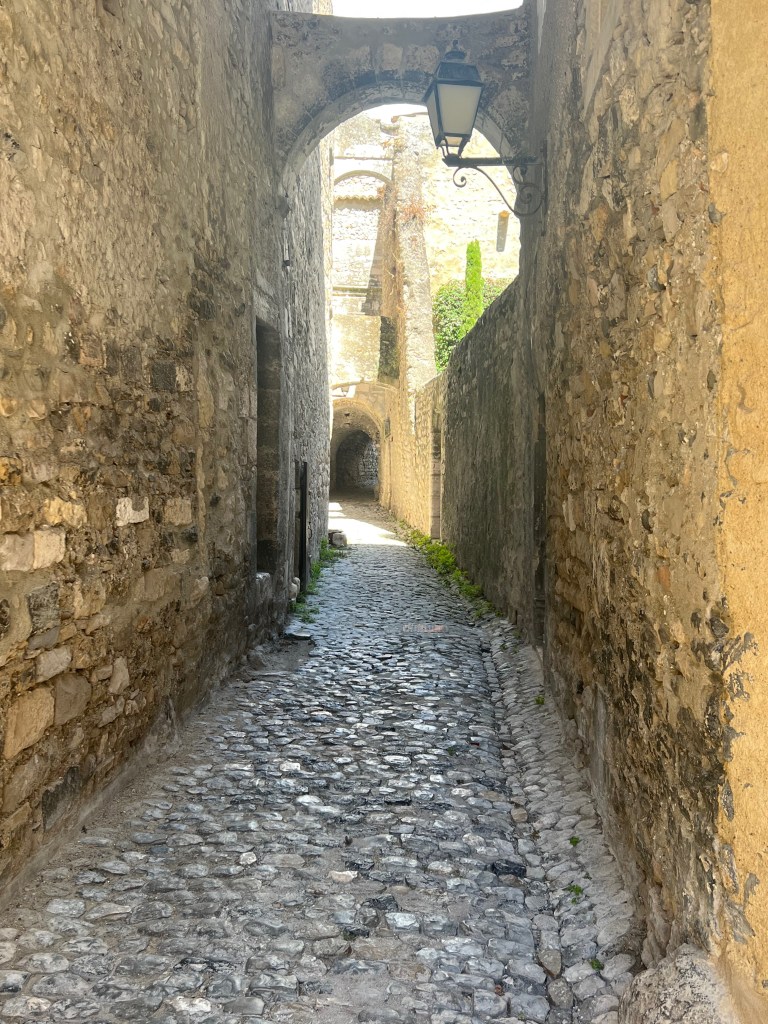
Who, you are wondering, is Chrétien de Troyes and who were Abelard and Héloïse? Well, Chrétien de Troyes was actually the author of the Arthur, Lancelot, Guinevere, Holy Grail, and Round Table stories and books. Those stories are actually considered French, not English (Lancelot du Lac was a French knight). In fact, J.R.R. Tolkien wrote the Lord of the Ring stories because he thought England needed its own mythology; Camelot being “too French.”
Need a little medieval literature and history in your life? This video is excellent.
I was very excited to visit Viviers because I felt like it would feel as if Camelot were coming to life (even though, of course, I have also been to what is considered to be the birthplace of Arthur in Cornwall, England, which actually did feel magical and historical at once).

Viviers is not at all Arthurian, which I found out from our guide, whose parents arrived in Marseille in the mid-50s, having left Vietnam with the French. Here she is talking to a man who was leaving his house in Viviers while we were on our tour. He’s the town baker.
Anyway, I asked her whether this medieval village had anything to do with the legends, and the answer was no. Oh well, it was still a romantic village. In fact, she said, French schoolchildren (unlike British schoolchildren) don’t learn anything about Lancelot because the stories were written in Old French and no one has any interest. What a pity!
I asked her if the schoolchildren learned about Charles Perrault who wrote the fairy tales Cendrillon (Cinderella) and Le Petit Chaperon Rouge (Little Red Riding Hood), among others (yes, he came before the German Brothers Grimm). Oui, she said, they do learn those fairy tales.
Then, I wondered where Abelard and Héloïse, the great French lovers were in their lifetimes; perhaps they lived in Viviers, even though there is absolutely no mention of them. Non, they were in and around Paris and the Brittany region (northwest France). Abelard and Héloïse, if you don’t know, fell in love when he was her tutor. Her uncle found out she was pregnant (this was in the 12th century) and had Abelard castrated (by a mob) and sent Héloïse to live in a nunnery (this is a little disputed, even by them in their letters), where she became a very important thinker of her time (as did he). You think that’s tragedy? Their son was named Astrolabe. Even back then celebrities tortured their children with ridiculous nomenclature.
So, no medieval romance in the town of Viviers, but it did feel very romantic with the mistral (wind) and the lovely stone buildings and narrow streets. I saw this doorway and these weird Dr. Seuss plants.

When we returned to the ship, I was showing a steward my pictures since he asks about my writing everyday and he told me I should write romance novels.

Tonight, I will leave you with one of the greatest songs ever written which mentions two of France’s writers of an entirely different era (and crazed lovers): Rimbaud and Verlaine. This is my absolute favorite version of this song.
 yogadonna
Leave a comment