
Yesterday, we went to the Fragonard museum and the Dior museum. Fragonard is an almost 100-year-old fragrance house, and, although I find many of their perfumes old-fashioned and soapy, I was excited to learn more about the making of perfume and we took a class and made our own fragrances (although we didn’t have many scent options, so the creativity was limited).
Then, we went to the new Dior museum which is, in a word, spectacular. The designers of the exhibits really understood how the guests wanted to be wowed by the clothes as well as the space.
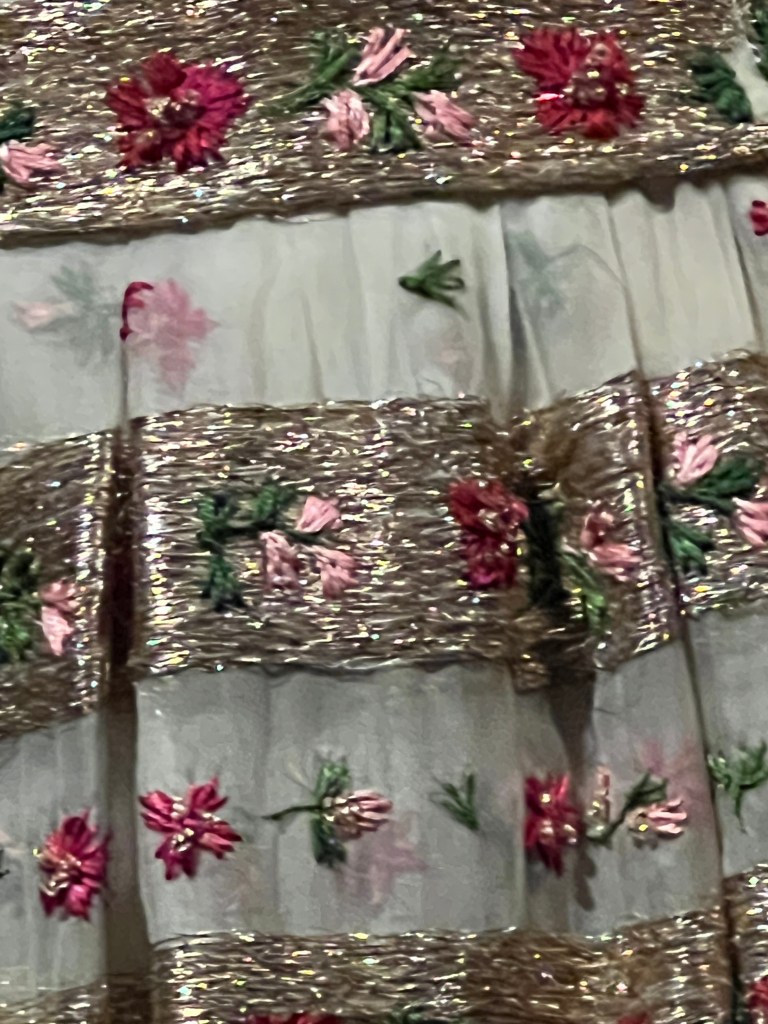
Unless you’ve seen haute couture up close, you really can’t appreciate just how artistic and beautiful it is. It’s a shame that designers get all the credit, because, really it isn’t their work that should receive the applause. Designers sketch, drape, or, sometimes, just imagine their ideas, and it is up to the première (head) of the ateliers (studios) to bring the dreams to life.
Then, of course, it is up to the various petit mains (small hands; how sexist is that?)—embroiderers and seamstresses—to turn the dress from fabric to elaborate creation.
Here is a Dior dress and a close-up of the handwork that went into it:
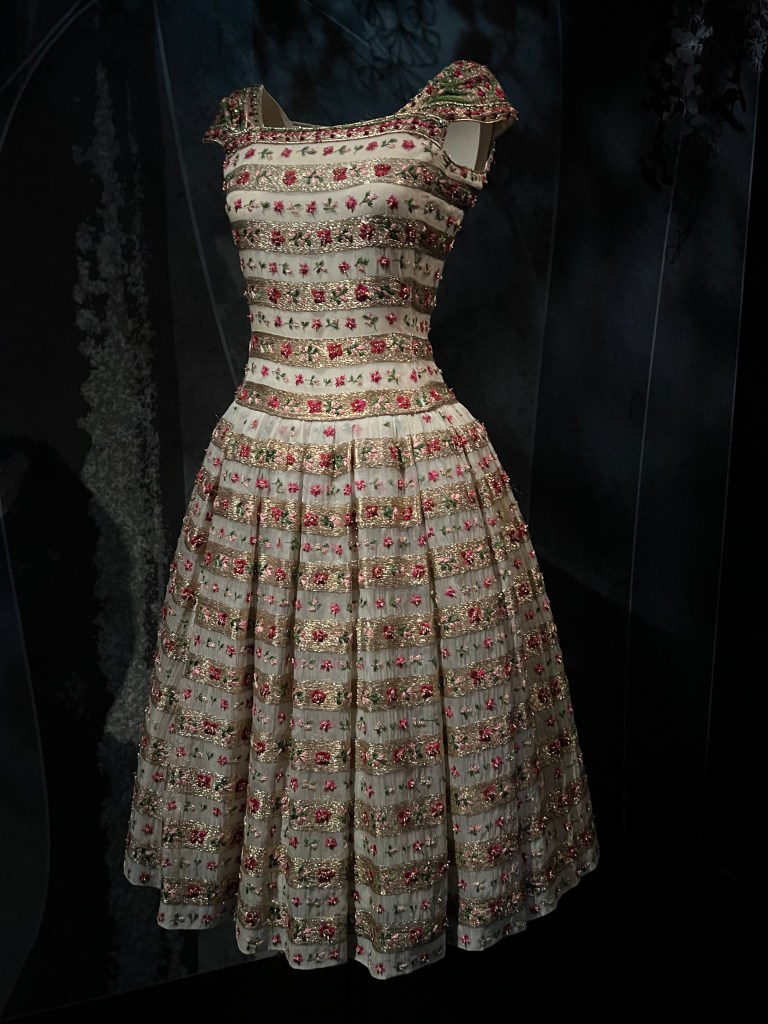
Here is another extraordinary display of dresses.
One of the most extraordinary aspects of Christian Dior’s story is not his, but his sister’s, Catherine. She was a resistance fighter in WWII and ended up in Ravensbrück. After the war, she inspired his first fragrance, Miss Dior, after and, as the hosts of my trip said, she, more than her brother, deserves our attention.
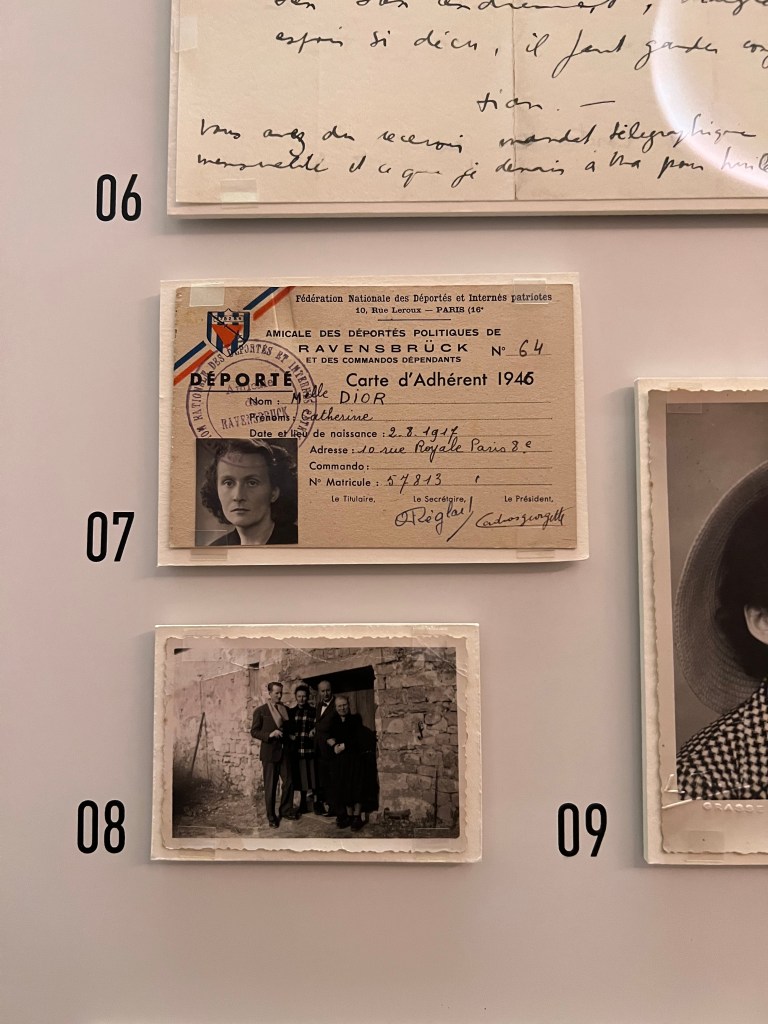
If you want to read more about her, I recommend the book, Miss Dior: A Story of Courage and Couture by Justine Picardie. The haute couture business is enormous in Paris and all of France, and was just as significant pre-World War II as it is now. When the Nazis marched into Paris (one might say they were, in some ways, almost welcomed), their idea was to move the entire haute couture industry (i.e., the people) to Germany, most likely Berlin, so the designers had to fight that plan. Of course, the Nazis took over many French homes (especially those that had belonged to Jews) and the Paris couturiers had to decide whether to dress German wives or not. Infamously, Coco Chanel, an antiSemite, entered into a romantic relationship with a high-ranking German intelligence officer and became an intelligence operative for the Nazis. Dior, on the other hand, fought to keep the industry in France and, although the details are unclear, seems to have tried to help his sister. For her work, France awarded her the Croix de Guerre, the King’s Medal for Courage in the Cause of Freedom, and the Legion of Honour.
Of course, there was barely any mention of her in the Christian Dior museum.
My fourth trip to Paris is now over—or close to over—as I sit in Charles DeGaulle waiting for a flight that isn’t cancelled or delayed due to weather on the East Coast. I honestly feel like I experienced Paris the way I’ve always wanted to. I know it was just over a week, but I did feel like I lived there. I was able to walk around the majority of the city without a map or directions. I went to museums and all sorts of restaurants. We had beautiful days, rainy days, and hot days. Also, I wrote a lot, and I even wrote a story for Bicycling (not out yet) that made me very proud. I feel like I know Paris.
“There are only two places in the world where we can live happy: at home and in Paris.” ~ Hemingway


 yogadonna
Leave a reply to Gabrielle Revere Cancel reply